
Lanier County Warrant Limits
Lanier County research did not confirm a public Sheriff active-warrant list or county-branded warrant lookup. The Sheriff's Office says one primary function of the Office of Sheriff is serving as officers of the court, including processing warrants and judicial orders for Superior Court. That makes the Lanier County Sheriff's Office the local law enforcement contact for warrant-related questions, but it does not mean every active warrant can be confirmed by phone or released under open-records rules.
Magistrate Court is also central because its jurisdiction includes warrant applications and preliminary criminal proceedings. Lanier County Magistrate Court shares public-access infrastructure with the local Probate/Magistrate website and the Georgia Magistrate Records ecosystem. However, the Georgia Magistrate Records arrest-warrant search did not show Lanier County in the visible county dropdown when inspected. That limitation should be treated as a real access warning unless the portal is rechecked and Lanier later appears.
The Georgia Magistrate Records arrest-warrant search shows a warrant search form, but the Lanier research found that Lanier was not visible in the county dropdown at inspection.
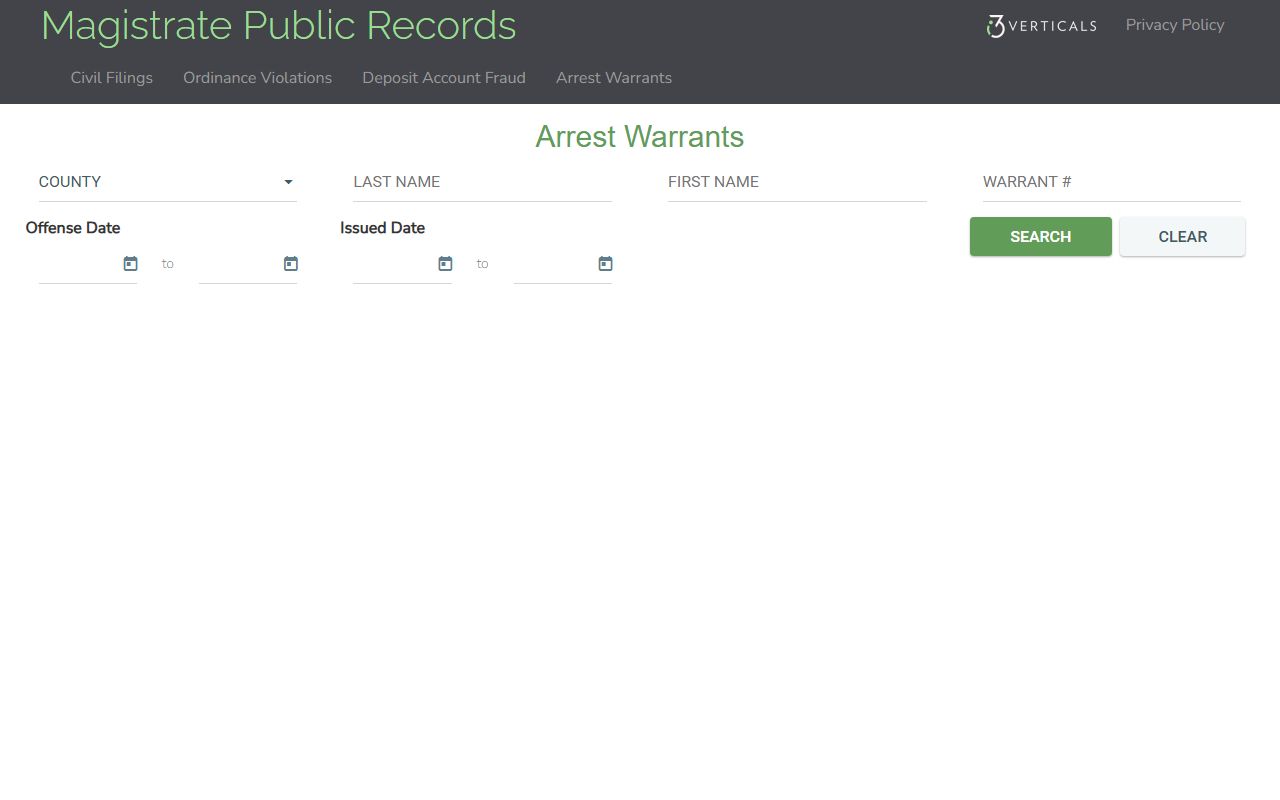
Because of that dropdown limit, Lanier users should not rely on the portal as a confirmed Lanier County active-warrant search without checking the current county options.
Types of Lanier Warrants
Different warrant types live in different parts of the local record system. A criminal arrest warrant may begin with a Magistrate Court application or law enforcement investigation. A bench warrant may be connected to a missed court date or failure to comply with a court order. A search warrant is often investigative and may remain sealed while an investigation is active. A traffic failure to appear may lead to DDS license consequences and court reengagement steps, even when the local traffic page focuses more on suspension than a public warrant list.
- Arrest warrant - a judicial order authorizing arrest when probable cause is found.
- Bench warrant - a judge-issued warrant often tied to missed court, contempt, or failure to obey an order.
- Search warrant - an order authorizing a search, commonly restricted while an investigation is active.
- Probation warrant - a warrant or hold tied to alleged violation of probation conditions.
- Traffic FTA consequence - a missed traffic case can trigger DDS license suspension and court reengagement requirements.
- Fugitive or outside warrant - an out-of-county hold may require confirmation by the issuing agency before transport or release decisions.
How to Search Lanier County Warrants
The safest Lanier County warrant search starts with the likely source of the warrant. If the matter involves arrest, custody, service of court orders, or a Sheriff's hold, call the Lanier County Sheriff's Office at (229) 482-3545. If the matter involves a warrant application, preliminary hearing, or Magistrate Court proceeding, contact Lanier County Magistrate Court at 56 W. Main Street, Suite 10, Lakeland, phone (229) 482-2207, or use records@lanierprobatecourt.gov for record-request routing where appropriate.
- Identify whether the issue is criminal, traffic, probation, municipal, or tied to a specific court case.
- Check court records first if there is a known case number, citation number, or missed hearing date.
- Call the Sheriff's Office for current warrant, jail, or surrender logistics, understanding that some active warrants may not be discussed publicly.
- Use the Magistrate Court contact for warrant applications and preliminary proceedings.
- For traffic FTA issues, contact Lanier Probate Court and the Georgia Department of Driver Services separately because DDS controls license reinstatement.
The nCourt Lanier Magistrate Court e-filing page identifies the local Magistrate Court e-filing route and court contact details.
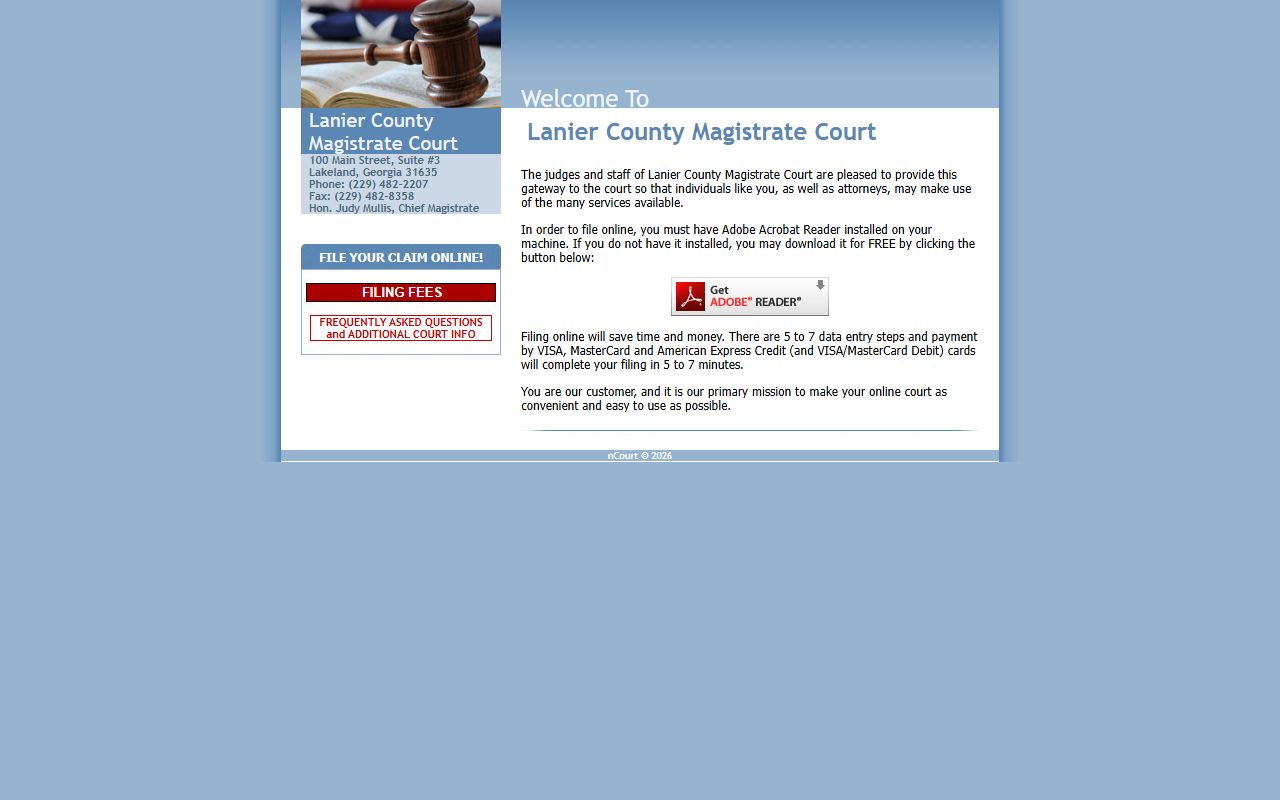
That filing portal supports the broader Magistrate Court access picture, but it is not a substitute for confirming an active warrant with the court or Sheriff's Office.
Lanier Warrant Search Fields
The Georgia Magistrate Records arrest-warrant form provides the best documented warrant-search field inventory, even though Lanier was not listed as a visible participating county when researched. The form uses date ranges rather than a public name-based Lanier warrant roster. If Lanier is added later, users should still confirm any result with the issuing court or Sheriff's Office before acting on it.
| Field Label | Type | Required | Notes |
|---|---|---|---|
| County | Dropdown | Unspecified | Visible options researched did not include Lanier County. |
| Offense Date | Date range | Optional or unspecified | Uses from and to date pickers. |
| Issued Date | Date range | Optional or unspecified | Uses from and to date pickers. |
| Search | Button | n/a | Runs the search for selected participating counties. |
| Clear | Button | n/a | Clears the form fields. |
What Warrant Records Show
A public Lanier County warrant record may be limited, especially if the warrant is active, sealed, juvenile-related, or tied to an ongoing investigation. When information is available, the record may identify the issuing court, warrant type, offense or charge, issue date, defendant name, bond conditions, case number, warrant number, and related court date. Court records may show a bench warrant or failure-to-appear entry even if no public warrant list exists.
| Field | What It Shows |
|---|---|
| Warrant number | Identifier assigned to the warrant or warrant application when released or visible. |
| Issue date | Date the judicial officer issued the warrant. |
| Charge or reason | Alleged offense, missed appearance, contempt issue, probation matter, or search authority. |
| Bond amount or condition | Release terms if set and publicly available. |
| Issuing court | Magistrate Court, Superior Court, Probate/traffic, municipal court, or another agency. |
| Status | Active, served, recalled, cleared, sealed, or unavailable to the public. |
The Lanier Magistrate Court fee schedule is relevant when a warrant-related Magistrate filing or court action has fees or costs tied to the case.
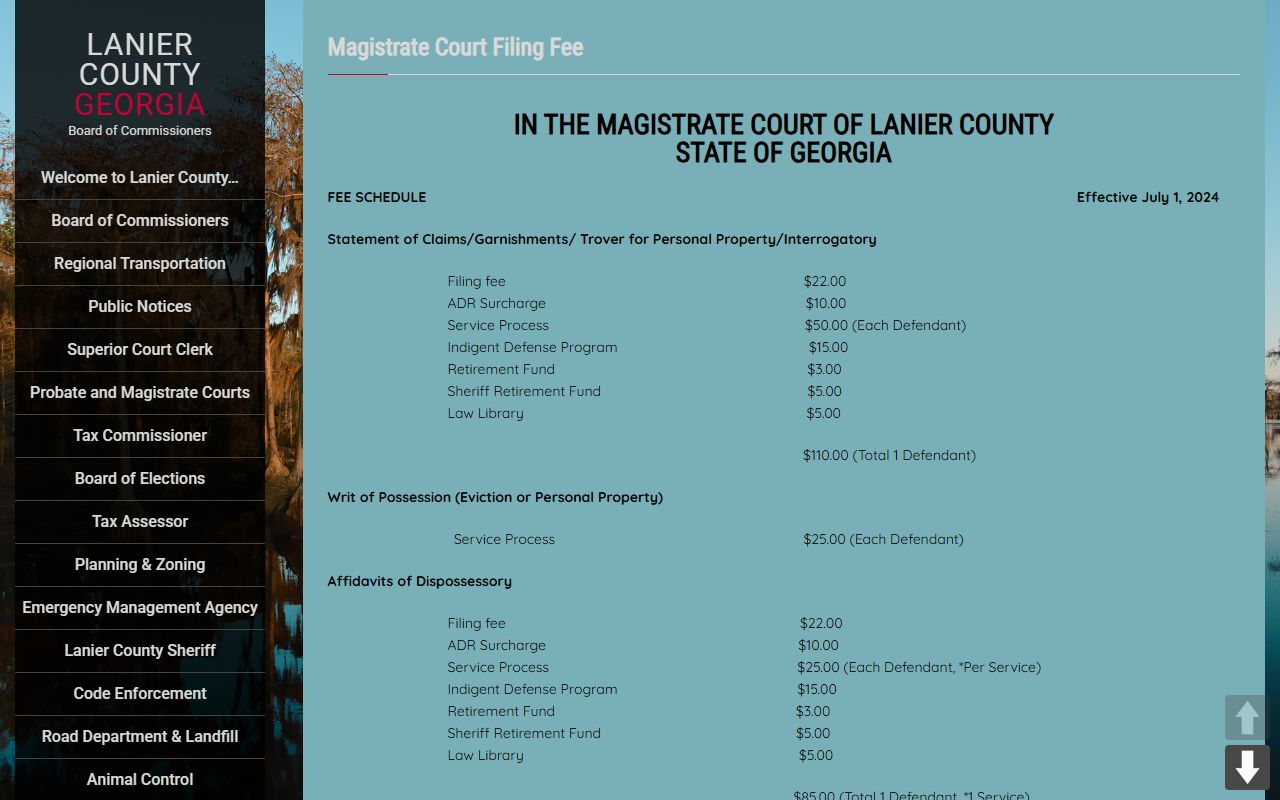
Fees and court costs should be confirmed with the court because warrant resolution can involve multiple records, filings, or separate traffic and DDS consequences.
Bench Warrants and FTA
A missed court date can create consequences beyond a public warrant search result. Lanier Probate Court's traffic materials explain that failure to appear or resolve a citation may result in DDS license suspension. Resolving the traffic case does not automatically reinstate the license because DDS controls reinstatement. In appropriate cases, the court may issue a Form 912 release to DDS once the person reengages and the matter is placed back on the calendar.
For traffic matters, contact Lanier Probate Court rather than assuming the Sheriff's Office can clear the license issue. For Superior Court criminal matters, the bench warrant or failure-to-appear entry may be reflected in the court file and in Sheriff's warrant processing. For Magistrate matters, the court can explain records routing but cannot provide legal advice about whether to appear, surrender, plead, or seek bond.
Resolve a Lanier Warrant
A person who believes there is an outstanding Lanier County warrant should avoid unofficial warrant-list websites and start with official offices or counsel. The first step is identifying the source: Sheriff's arrest or jail matter, Magistrate warrant application, Superior Court felony case, Probate traffic failure to appear, municipal citation, probation matter, or another county's warrant. The second step is confirming the case number, charge, court, and status through the proper custodian.
Criminal warrants may require arranging surrender, bond, or a court appearance through the Sheriff's Office, the issuing court, and counsel. Traffic FTA cases may require a new court date, payment or contest process, and DDS reinstatement steps. After any warrant or FTA is addressed, confirm that the court record, DDS record, and law enforcement status have all been updated because those systems do not always clear at the same moment.
Lanier Probate Court's traffic materials are especially important for missed citations. The local page says traffic court is held on the third Thursday of each month, with arraignments at 9:00 a.m. and bench trials at 1:00 p.m. Continuance requests must be made at least 48 hours before the scheduled date and are subject to approval. Those rules do not resolve a criminal warrant, but they give a concrete path for a traffic failure-to-appear issue before license consequences grow.
Important: Speak with an attorney before appearing on a criminal warrant if arrest, bond, or probation consequences are possible.
Restricted Lanier Warrant Records
Not every warrant record is public. Search warrants may be sealed or unavailable while an investigation is active. Juvenile warrants and juvenile court material are restricted. Active investigative records, safety-sensitive records, victim information, and personal identifiers may be withheld or redacted under Georgia law. A Sheriff's open-records request can be used for records that can be released, but the custodian may lawfully withhold records covered by an exemption, court order, or confidentiality rule.
Open-records requests should be precise. For Sheriff's records, the local ORA form asks for requester contact information and a clear description of the record. For Probate, Magistrate, or traffic records, the records request form asks the requester to choose the court division, provide the case number if known, list party names, give a date range, and describe the documents wanted. A vague request such as "all warrants" is less useful than a request tied to a person, case, date range, and issuing court.
No public statewide Georgia active-warrant search for the general public was located in the research. GBI and GCIC law-enforcement systems are not public warrant databases. The GBI sex offender registry is a separate public registry, useful for registered sex offender information, not for ordinary warrant status.
The GBI sex offender registry public search is one statewide public safety search that should not be confused with an active-warrant database.
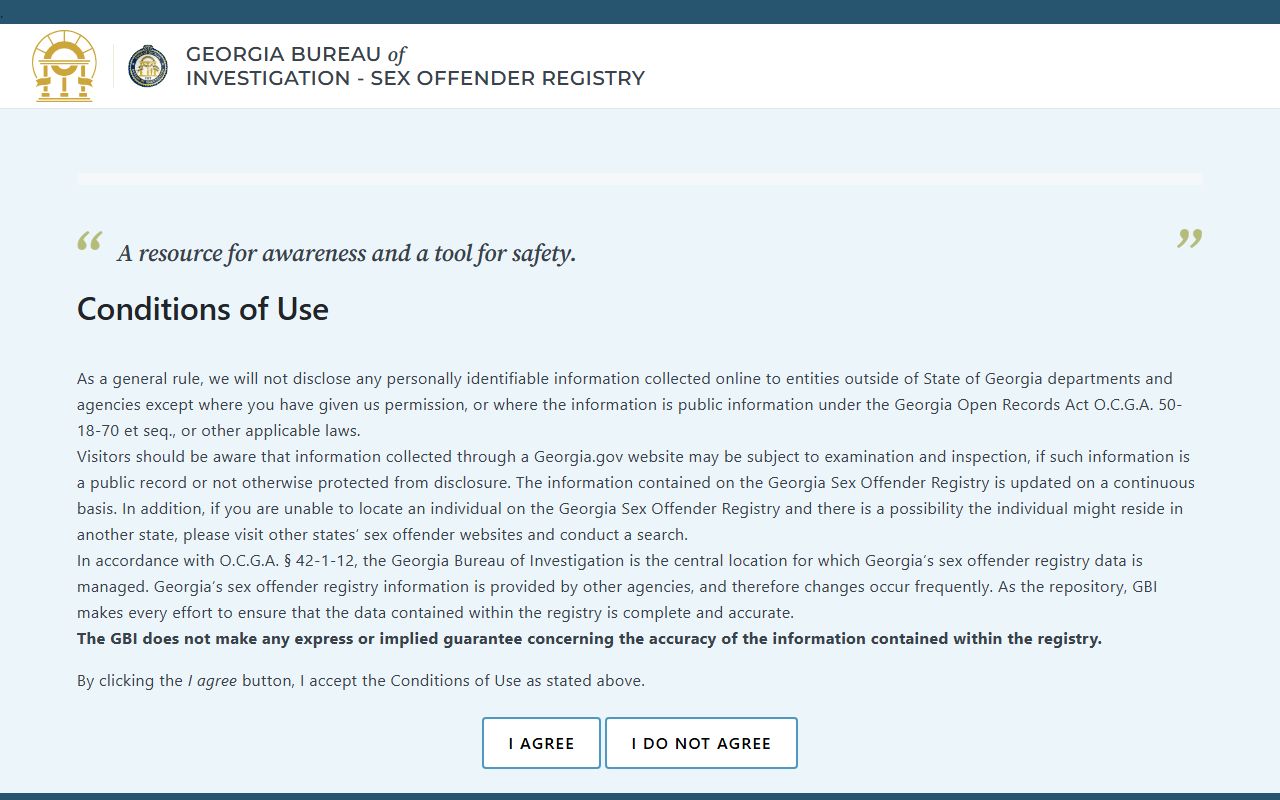
Use the registry for publishable sex offender information under Georgia law, then use the Sheriff's Office or court custodian for warrant-specific questions.