
How to Search Lanier County Court Records
Lanier County Court records do not sit behind one county-wide public search box. The first choice is the court level. Superior Court and Juvenile Court records are tied to the Lanier County Clerk of Superior Court, while probate, marriage, guardianship, will, and traffic records are routed through Probate Court tools. Magistrate civil, ordinance, deposit account fraud, and some lower-court records are searched through Georgia Magistrate Records when Lanier appears in the relevant module.
Use the most exact facts available before searching: a case number, citation number, party name, court division, offense date, filing date, or court date. Online dockets can help locate a record, but certified copies and non-online files still come from the custodian. Superior Court copies go to the Clerk of Superior Court. Probate, Magistrate, and Traffic requests go through the Lanier Probate/Magistrate records request process. Sheriff incident, arrest, accident, jail, and booking records use the Sheriff's open-records process.
- Identify the court or agency. Felony, divorce, land, equity, and larger civil records belong with Superior Court; probate, marriage, traffic, wills, and guardianships belong with Probate Court; small civil claims, ordinance matters, DAF, and preliminary criminal matters belong with Magistrate Court.
- Search the official online channel first. Use Georgia Probate Records for probate, marriage, traffic, and related Probate Court modules, Georgia Magistrate Records for participating Magistrate searches, and Georgia Courts E-Access or re:SearchGA for provider-based Superior Court access when available.
- Save the identifiers shown in results. Case numbers, filing dates, party names, citation numbers, docket dates, and court division labels make later records requests faster.
- Ask the custodian for non-online files or certified copies. The clerk, court office, or sheriff may need a written request, fee estimate, or proof of eligibility.
- Check restrictions before relying on a missing result. Juvenile, sealed, restricted criminal, adoption, mental health, and personal-identifier material may be withheld or redacted.
The GSCCCA Lanier County Clerk directory identifies the Superior Court clerk office and its public contact details.
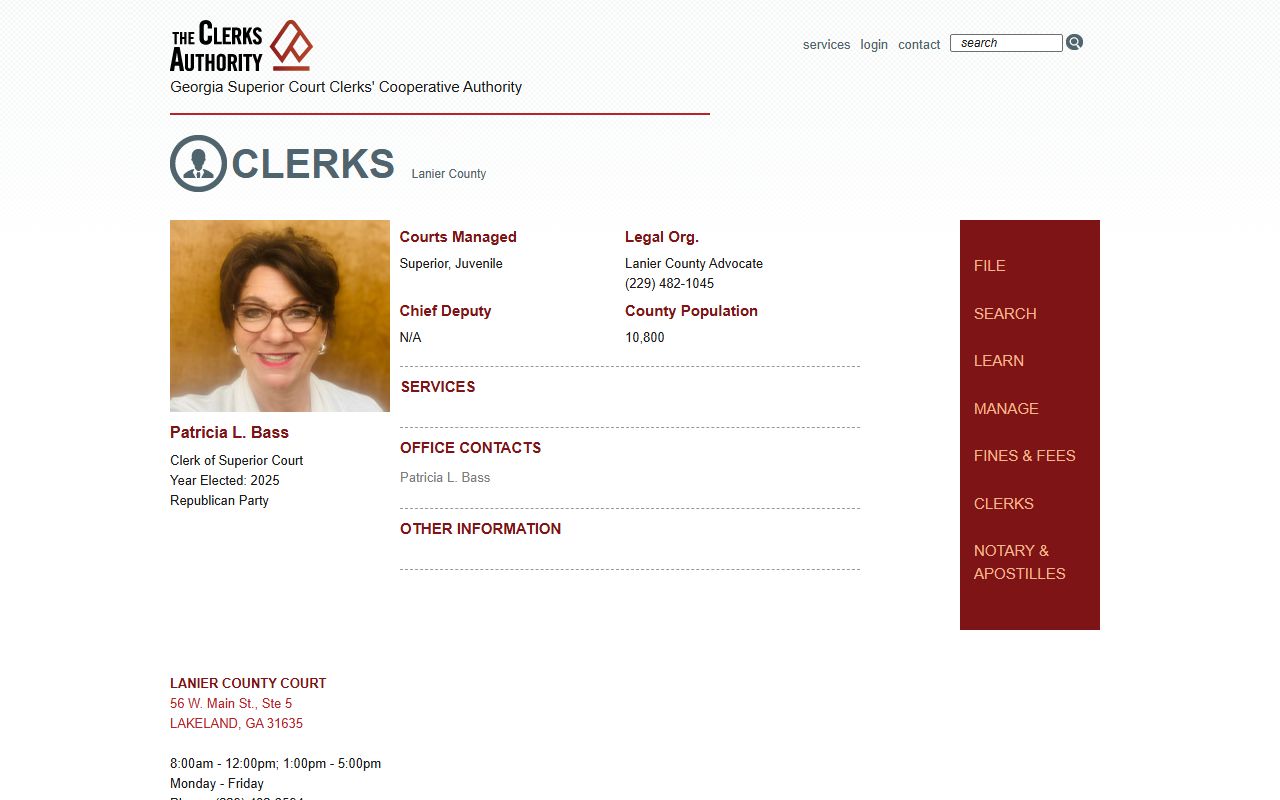
That clerk listing is the practical starting point for Lanier County Superior Court records, divorce decrees, and certified copies that are not available through a provider.
Lanier County Court System
Georgia county trial courts are not called district courts. Lanier County's broad trial court is Superior Court, and it sits in the Alapaha Judicial Circuit with Atkinson, Berrien, Clinch, Cook, and Lanier counties. Superior Court handles felonies, divorce, equity, land-title matters, and civil cases outside lower-court jurisdiction. The Clerk of Superior Court manages Superior and Juvenile Court records.
Lower court access is split. Probate Court handles wills, estates, guardianships, conservatorships, marriage licenses, vital-record functions, weapons carry, and Lanier traffic matters. Magistrate Court handles civil claims generally under $15,000, dispossessory cases, garnishments, deposit account fraud, warrant applications, preliminary criminal proceedings, and county ordinance matters. Municipal Court may matter if a city citation was issued inside municipal limits.
Case flow: Law enforcement or filing event › Magistrate, Probate, or Superior Court › trial-level docket and orders › Court of Appeals of Georgia or Supreme Court of Georgia when appeal rules allow.
| Court | Jurisdiction | Case Types |
|---|---|---|
| Superior Court | General trial jurisdiction | Felony, divorce, equity, title-to-land, larger civil, appeals where allowed |
| Probate Court | Probate and statutory local matters | Estates, wills, guardianships, conservatorships, marriage licenses, vital records, traffic |
| Magistrate Court | Limited civil and preliminary criminal matters | Claims under $15,000, dispossessory, garnishment, DAF, warrants, ordinance violations |
| Juvenile Court | Juvenile matters | Cases involving minors, with access limited by law |
The Georgia Superior Courts Lanier County page confirms the local Superior Court address and clerk reference.
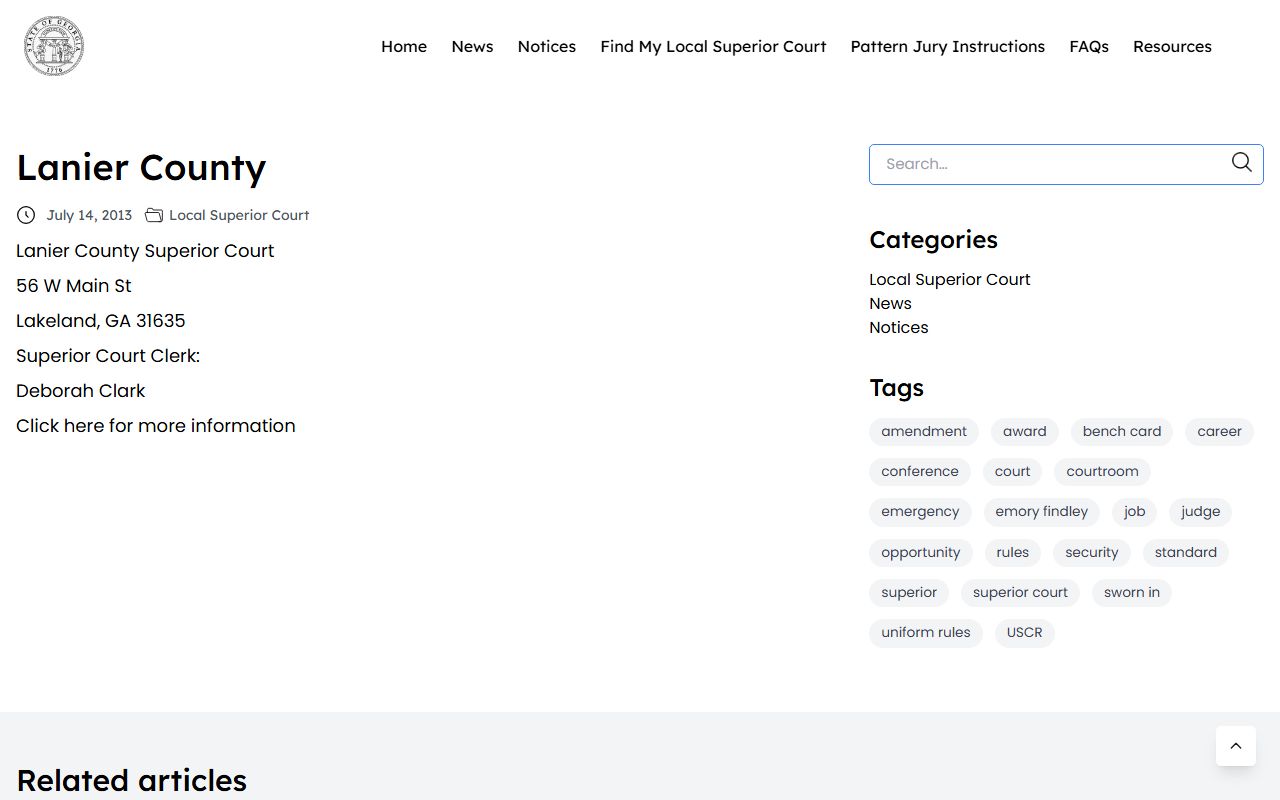
That statewide court listing helps separate Superior Court records from Probate Court, Magistrate Court, and sheriff records.
Lanier County Court Offices
The main public court offices are concentrated at the Lanier County Courthouse in Lakeland. Suite 5 is the Clerk of Superior Court for Superior and Juvenile Court records. Suite 10 is used by Probate Court and Magistrate Court for probate, marriage, traffic, Magistrate civil, DAF, ordinance, and records request matters. The Sheriff's Office and Jail are nearby on West Church Street and handle jail, arrest, incident, accident, warrant-processing, civil-paper, and courtroom-security functions.
Clerk of Superior Court
56 W. Main St., Suite 5
Lakeland, GA 31635
(229) 482-3594
8:00 a.m.-12:00 p.m.; 1:00 p.m.-5:00 p.m. Monday-Friday
Probate Court
56 W. Main Street, Suite 10
Lakeland, GA 31635
(229) 482-3668
records@lanierprobatecourt.gov
Magistrate Court
56 W. Main Street, Suite 10
Lakeland, GA 31635
(229) 482-2207
records@lanierprobatecourt.gov
Sheriff's Office and Jail
63 West Church Street
Lakeland, GA 31635
(229) 482-3545
records@lanierso.com for records requests
The Lanier County Board of Commissioners homepage lists local department phone numbers for Superior Court, Probate, Magistrate, and the Sheriff's Office.

The county phone list is useful when a record search reaches the wrong office and needs to be routed to the correct court counter.
Lanier County Court Record Types
Lanier County court records include civil, criminal, family, probate, traffic, Magistrate, and Juvenile Court materials. Each file type has a different custodian. A felony case file is not searched the same way as a Probate estate, a traffic citation, a Magistrate dispossessory case, or a Sheriff's arrest report. The record title should guide the search path before a requester spends time in the wrong portal.
Superior Court is the safest route for divorce decrees, felony cases, equity, land-title matters, and larger civil cases. Probate Court is the route for estates, wills, guardianships, conservatorships, marriage licenses, vital records, weapons carry, and traffic records. Magistrate Court is the route for lower civil claims, dispossessory, garnishment, DAF, ordinance, warrant application, and preliminary criminal records. Juvenile records are not ordinary public records.
- Criminal court records include charges, pleas, motions, bond orders, dispositions, sentences, and appeal notices in Superior Court files.
- Civil court records include complaints, answers, motions, judgments, garnishments, dispossessory cases, and small civil claims.
- Family and divorce records include divorce pleadings, decrees, settlement terms, support forms, custody orders, and later modifications when public access is allowed.
- Probate records include wills, estates, letters, inventories, annual returns, guardianship, conservatorship, claims, and miscellaneous filings.
- Traffic court records include citations, court dates, pleas or payments, failure-to-appear actions, fines, DDS notices, and Super Speeder issues.
- Sheriff records include incident, accident, arrest, jail, booking, warrant-processing, and civil-paper service records when public release is allowed.
What Lanier County Court Records Show
A Lanier County court record usually identifies the court, case type, parties, dates, filings, orders, and outcome. Criminal and traffic files may add charges, statute references, bond, plea, sentence, fines, probation, restitution, and DDS consequences. Probate files may show a decedent, heirs, personal representative, ward, protected person, petition type, letters, claims, inventories, returns, and hearing dates. Civil files may show the claim, service, answer, motions, judgment, garnishment, or enforcement action.
| Field | What It Shows |
|---|---|
| Case Number or Citation Number | Identifier used for portal searches, copy requests, payments, and court-counter lookup. |
| Filing, Offense, or Court Date | Date range used by Magistrate, Probate, traffic, and Superior Court searches. |
| Parties | Plaintiff, defendant, petitioner, respondent, decedent, heir, applicant, ward, protected person, or accused. |
| Charges or Cause | Criminal charge, traffic offense, civil claim, probate petition, ordinance violation, or DAF matter. |
| Docket Entries | Chronological filings, hearings, motions, notices, orders, continuances, pleas, judgments, and closures. |
| Disposition, Sentence, or Judgment | Outcome such as dismissed, judgment, conviction, paid, closed, transferred, restricted, sentence, or probation. |
Lanier County Public Access Laws
Georgia public access starts with the rule that public records are open unless a law or court order says otherwise. That does not mean every Lanier County court document is online, free, or complete. A public docket entry may be visible while the PDF document remains unavailable online. A clerk or court may also redact Social Security numbers, financial account data, minor names, medical details, victim information, and other protected identifiers.
Key Statutes:
O.C.G.A. 50-18-70 through 50-18-74 says Georgia public records are generally open for inspection and copying unless exempt.
O.C.G.A. 50-18-71 guidance explains access procedures and lawful charges for copying, search, retrieval, redaction, or supervision.
Uniform Superior Court Rule 21 treats Superior Court files as public unless access is limited by law or court order.
O.C.G.A. 35-3-37 governs criminal history record restriction for eligible records.
Restricted Lanier County Court Records
Restricted Lanier County court records include Juvenile Court files, sealed criminal records, restricted criminal history, adoption records, mental health proceedings, and court documents with protected personal identifiers. Juvenile records are especially limited because the Clerk of Superior Court manages Juvenile Court records along with Superior Court records, but juvenile files are not treated like ordinary public civil files.
Georgia uses the term record restriction for many criminal-history limits. For arrests after July 1, 2013, GBI guidance routes many requests through the prosecutor rather than a new application with the arresting agency. For older arrests, the person may need to apply through the arresting agency. If prosecutor or court approval is required, the approved restriction must be sent to GCIC. Court-file sealing can be a separate issue from criminal-history database restriction.
Lanier County Probate and Magistrate Records
Lanier's Probate and Magistrate access is unusually detailed for a small county. The local Probate Court website links to Georgia Probate Records for estate, marriage, traffic, will, guardianship, death, calendar, miscellaneous filing, weapons carry, and petition fee tools. The Magistrate Court page links to Georgia Magistrate Records for participating civil, ordinance, and deposit account fraud searches, plus e-filing and payment tools. The courts share a public web platform, but each court keeps its own statutory authority.
The Lanier County Probate and Magistrate Courts page gives the local judge, courthouse suite, phones, email, and vital-record notes.
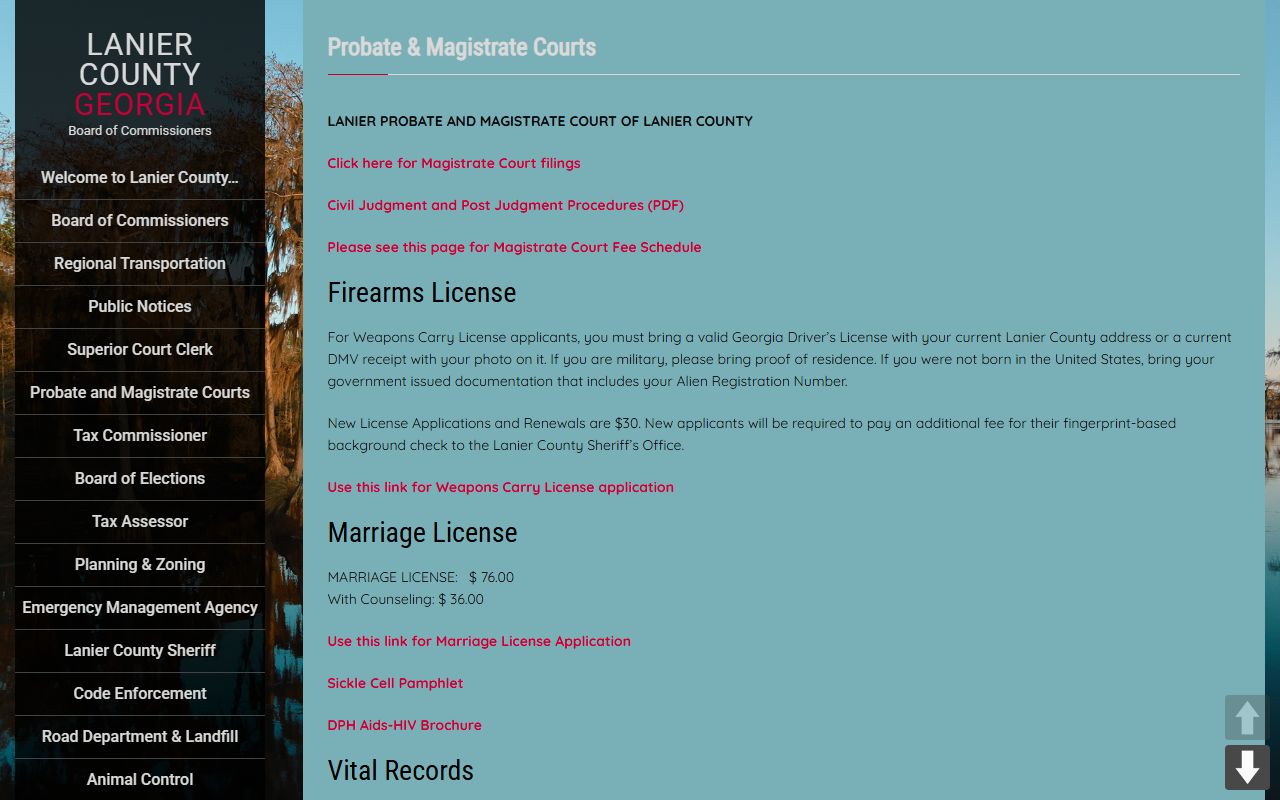
That county office page supports the fallback route when a probate, magistrate, or traffic record is not found in a portal.
| Portal or Form | Lanier County Court Records Access |
|---|---|
| Georgia Probate Records | Estate, recorded marriage license, traffic docket, will, guardianship, death, hearings, miscellaneous filings, weapons carry, and petition fee modules. |
| Georgia Magistrate Records | Civil filings, ordinance violations, deposit account fraud, filing fee tools, e-filing, payment, and some court records for participating courts. |
| Probate/Magistrate/Traffic records request | Copies of court records not available online, routed by division to Probate Court, Magistrate Court, or Traffic Court. |
| Georgia Courts E-Access | State court e-access page that redirects users to a provider website and requires an account. |
| re:SearchGA and PeachCourt | Provider-based Georgia case, document, and e-filing channels when the court and record type are available. |
Lanier County Sheriff and Jail
The Lanier County Sheriff's Office matters to court-record users because the sheriff serves as an officer of the court. Sheriff Nick Norton's office handles courtroom security, warrants and judicial orders for Superior Court, civil paper service, jail custody, inmate movement, and law-enforcement records. The Sheriff's Office and Lanier County Jail are listed at 63 West Church Street or Road in Lakeland, with the main phone number (229) 482-3545.
No official Lanier County online inmate roster or official sheriff mobile app was found in local official materials. Current custody questions should go to the Sheriff's Office/Jail by phone or in person. Sentenced state-prison or probation searches use the Georgia Department of Corrections offender query, while sex offender searches use the GBI sex offender registry. Incident, accident, booking, arrest, and jail records use the Sheriff's open-records request process when records are public and available.
The Lanier County Sheriff's Office homepage describes the office's court, warrant, civil service, jail, and public safety functions.
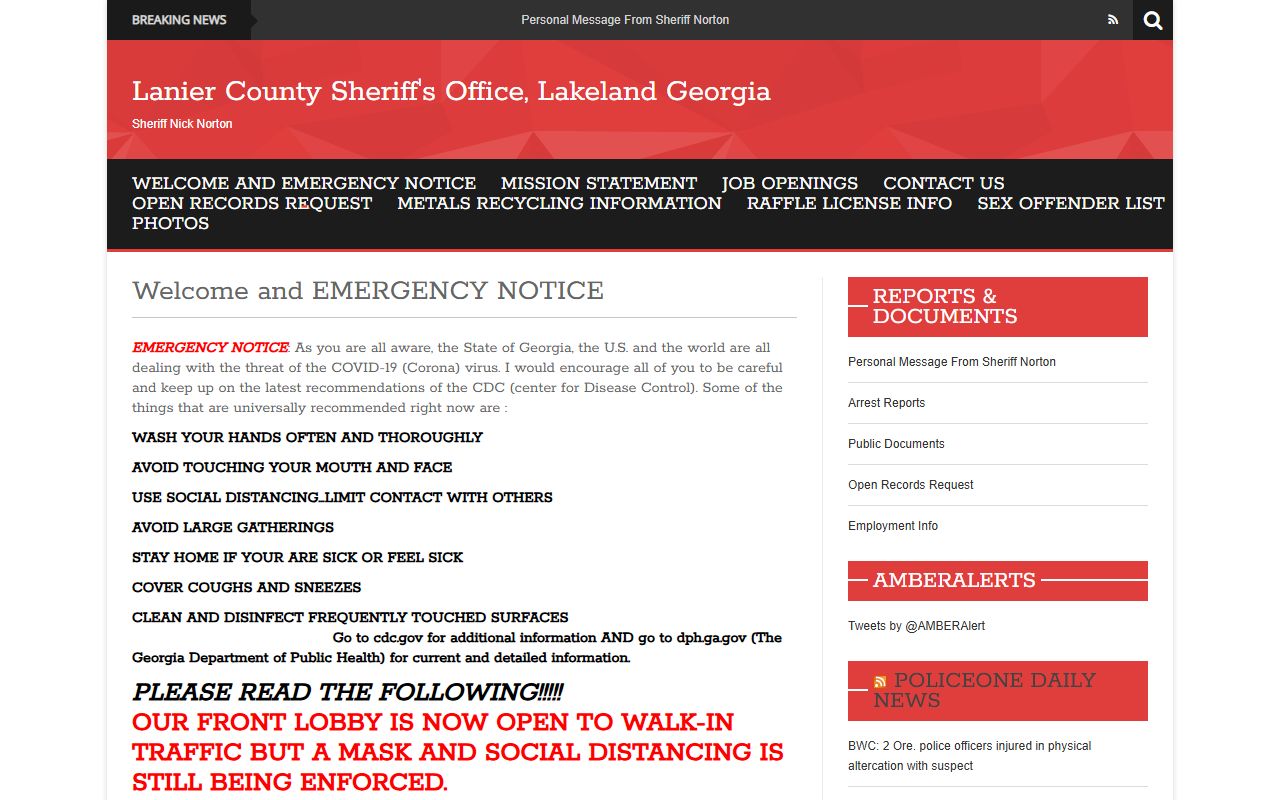
The sheriff channel is separate from court dockets, but it often supplies the arrest, booking, jail, warrant-processing, and incident records tied to a court case.
Marriage, Divorce, and Probate Court
Marriage licenses and probate filings are Probate Court records in Lanier County. Both marriage applicants must appear together, and an online application does not remove the in-person requirement. Recorded marriage licenses may be searched through Georgia Probate Records, but local Probate Court materials state that the marriage application itself must be requested from Probate Court. Probate filings include estates, wills, guardianships, conservatorships, safe-deposit-box petitions, successor executor petitions, inventories, annual returns, claims, and miscellaneous filings.
Divorce records follow a different route. Georgia.gov says divorce verification may be available through state vital-record channels, but copies of divorce decrees must be requested from the Superior Court Clerk in the county where the divorce was granted. For Lanier County, that means the Clerk of Superior Court at Suite 5. Probate Court remains the local route for marriage licenses, marriage record amendments, probate filings, traffic, and many vital-record services.
- Testator
- A person who made a will.
- Executor
- The person named to carry out a will after court authority is granted.
- Conservator
- A court-appointed person who manages another person's property or finances.
- Guardian
- A court-appointed person who makes personal care decisions for a minor or adult when allowed by law.
Lanier County Court Records Fees
Lanier County record fees depend on the office and record type. Exact Superior Court copy, certification, and search fees were not posted in official local sources, so requesters should ask the Clerk of Superior Court before ordering certified copies. Probate, Magistrate, and Traffic records requests state that fees may apply for copies, certification, or extensive research time as permitted by law. Sheriff's Office records requests may lead to a cost estimate after the office reviews the precise records sought.
| Item | Amount or Source |
|---|---|
| Superior Court plain copy | Fee not located in official sources, ask the Clerk of Superior Court. |
| Superior Court certified copy | Fee not located in official sources, ask the Clerk of Superior Court. |
| Probate/Magistrate/Traffic copies or certification | Fees may apply under the records request process. |
| Sheriff incident, accident, arrest, or jail records | Estimate provided after a precise ORA request when costs apply. |
| Traffic phone card payment | 4.7% vendor convenience fee noted by the local traffic page. |
How to Interpret Lanier County Court Records
Read a Lanier County court record by separating allegations, court events, and final outcomes. A charge is an accusation or citation. A conviction is a final result after a plea, trial, bond forfeiture, or other qualifying disposition. A docket is the dated list of events in a case, not always the full document set. A disposition is the outcome of a case or charge, such as dismissed, judgment entered, paid, convicted, transferred, restricted, or closed.
Traffic records need special care. Paying a traffic fine can count as a guilty or nolo contendere plea, waive trial, and create a conviction or bond forfeiture result. DDS driver records are separate from Probate Court traffic records. The court file may show the citation, court date, plea, fine, or failure to appear, while the Georgia Department of Driver Services controls license points, suspensions, reinstatement, and Super Speeder follow-up.
The Alapaha Judicial Circuit directory lists circuit judges, assistants, administrator contacts, and the Lanier law library contact.
Those circuit contacts help place a Lanier Superior Court case within the larger Alapaha Judicial Circuit rather than only the county courthouse counter.
Accuracy and Record Limitations
Online Lanier County court records can lag behind the court counter, and some portals show docket information without displaying full PDF documents. Traffic records are a clear example: public docket listings may be visible, but local traffic PDF documents are not available online according to the Probate traffic page. Magistrate records are generally retained approximately 10 years under the local records request page, so older lower-court records may require direct court contact or may not be available in the same way as a recent file.
Wrong or stale information should be checked with the office that created the record. Superior Court issues go to the Clerk of Superior Court. Probate, Magistrate, and Traffic records go to the records request process at records@lanierprobatecourt.gov. Sheriff incident, jail, arrest, and accident records go to the Sheriff's Office records custodian. A GBI criminal history issue may require prosecutor, arresting agency, court, or GCIC steps depending on the date and eligibility.
Note: Confirm court dates, warrants, license status, and certified-copy needs with the originating Lanier County office before acting on a portal result.
History of Lanier County Courts
Official court-history material for Lanier County is limited, so the most reliable current record is the office structure itself. The court functions remain concentrated at 56 W. Main Street, where the Superior Clerk, Probate Court, Magistrate Court, and Alapaha circuit staff contacts use separate suites. That setup matters more for records access than a courthouse chronology because a person must still route the record to the correct custodian.
Recent changes are better documented. The Alapaha Judicial Circuit gained a new Superior Court judgeship created by House Bill 55, and Governor Brian P. Kemp appointed Matthew B. Bennett to fill it. GSCCCA lists Patricia L. Bass as Clerk of Superior Court, year elected 2025. Lanier County Probate/Magistrate sources name Victoria Jewell as Probate Judge and Chief Magistrate, taking office January 1, 2025. The Probate/Magistrate website also centralizes modern tools for records requests, marriage applications, probate filing, traffic payment, and Georgia portal links.
Frequently Asked Questions
Where are Lanier County Superior Court records kept? Superior Court and Juvenile Court records are handled by the Clerk of Superior Court at 56 W. Main St., Suite 5, Lakeland. The clerk is the local route for Superior Court certified copies, divorce decrees, felony case files, land and equity matters, and older or non-online Superior Court records.
Can Lanier County Probate or Magistrate records be requested online? Yes. Probate, Magistrate, and Traffic records that are not available through the linked portals may be requested through the Lanier Probate/Magistrate/Traffic records request form. The form asks for contact information, court division, case number if known, party names, record type, date range, and a detailed description.
Is there a Lanier County online jail roster? No official Lanier Sheriff's online inmate search or jail roster was posted in local official materials. Current county jail custody questions should go to the Sheriff's Office/Jail at (229) 482-3545. State prison or probation searches use the Georgia Department of Corrections offender query.
Does Georgia Magistrate Records show Lanier warrants? The Georgia Magistrate Records portal has an arrest warrant search, but Lanier was not visible in that warrant dropdown when inspected. Warrant questions should be routed to the Sheriff's Office, Magistrate Court, Superior Court, or traffic court depending on the source of the warrant or failure to appear.
Which office handles Lanier County divorce records? Divorce decrees are Superior Court records. Georgia state vital-record resources may confirm some divorce facts, but certified divorce records must be requested from the Clerk of Superior Court in the county where the divorce was granted.
Are all Lanier County court records public? No. Public access is limited by law, court order, and record type. Juvenile, sealed, restricted criminal, adoption, mental health, and records with protected personal identifiers may be confidential, redacted, or available only to authorized parties.
Public Record Search
Sponsored Results